Task 7 of Multi4More will analyse data from the international LegacyNet to identify optimal grass, legume, and herb proportions for grassland mixtures. LegacyNet is a global network of experiments with 26 member sites that quantifies the effects of up to six grassland species in three functional groups on grassland responses.
Effects of plant diversity on yield were recently reported in Science. Across the 26 sites, multispecies mixtures achieved high yields due to strong grass-legume and legume-herb synergistic interactions – thus, the yield of the mixtures was much greater than the sum of the parts.
- Sowing two grasses, two legumes and two herbs each in approximately equal proportions can optimise yield and nitrogen-saving benefits
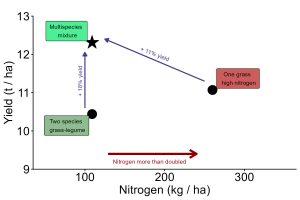
- The six-species multispecies mixture produced on average 12.3 tonnes per hectare per growing season, representing an 11% increase in yield compared to the grass monoculture that had more than double the nitrogen fertiliser, and an 18% increase in yield compared to the two-species grass-legume combination.
- The yield benefits of multispecies mixtures compared to less diverse grasslands were even stronger under warmer climates.
These results are available in the Open Access link to the Science publication.
In the next part of this work (2026), we will:
- investigate the effect of the legacy effects of plant diversity in a grassland ley on a follow-on crop
- investigate the effect of plant diversity on multiple agronomic functions (multifunctionality) in both the grassland and follow-on crop of the experiment
LegacyNet is a common field experiment conducted across 26 international sites that spanned a wide gradient of temperate climates and local conditions. LegacyNet is led by three scientists from Teagasc (John Finn), Trinity College Dublin (Caroline Brophy), and Aarhus University (Carsten Malisch). The LegacyNet sites include some in Ireland, as well as others across Europe – from Denmark to Italy, and the Netherlands to the Czech Republic – and further afield, from China to the US, Canada and New Zealand. What makes LegacyNet even more remarkable is that it is a voluntary network – participants and their institutions agreed to implement the scientific protocol at their own cost. the legacy effects of species diversity in a grassland ley on a follow-on crop